
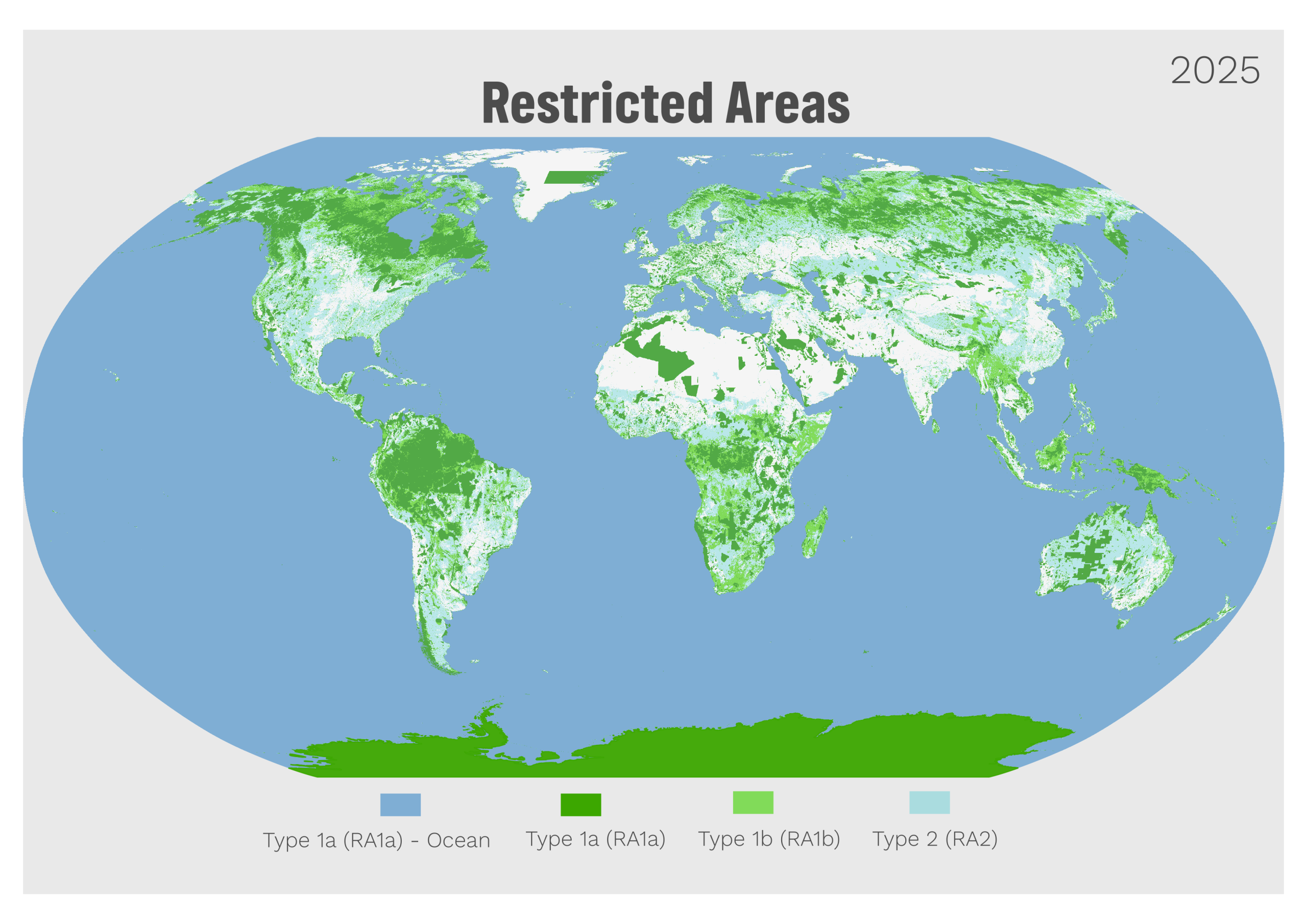
Global Restricted Areas Map
Identifying areas with high ecological, natural, and social values that should be off-limits to transition minerals mining
The global Restricted Areas Map for transition minerals mining has been defined by Greenpeace International to identify areas with high ecological, natural, and social values that should be off-limits to extractive activities such as transition minerals mining, in order to move the Earth’s trajectory to one that limits global average temperature rise to no more than 1.5°C while also respecting other crucial interconnected planetary boundaries as well as the rights of Indigenous Peoples and Local Communities. Combined with Reserve Proxy Areas, the mapping also provides an indicative analysis of transition mineral reserves outside of areas that must be protected to respect planetary boundaries and aims to raise the public debate on risks of mineral demand projections in the context of the energy transition.
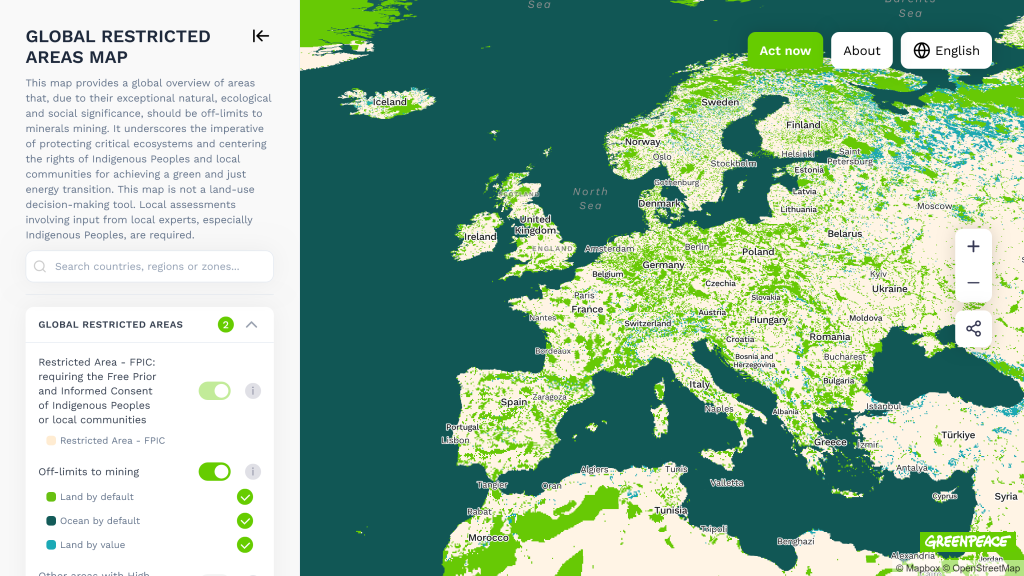
Based on criteria considering climate impacts, biodiversity, and nature, relevant spatial datasets have been identified which represent critical landscapes, protected areas, key biodiversity areas, ecosystems, carbon stocks, and water bodies. Valid global spatial datasets fulfilled some criteria: reliable sources (scientific), open data, the most up-to-date versions, the highest available spatial resolution and accuracy, and data format functionality (polygon, raster).
The available datasets were processed in Google Earth Engine to allow dynamic visualisation in order to analyse the datasets, performing, for instance, qualitative, comparative, and spatial representation checks. The initial variables were grouped into several normalised aggregated layers. Some of the datasets were considered a priori to be part of off-limits Restricted Areas in integral form (including, for example, Protected Areas, Intact Forest Landscapes, Mangroves, and the Global Ocean), whereas other datasets were reclassified to importance classes based on their values – Medium, High, and Very High.
Through an iterative process with the involvement of a group of experts, the methodology was optimised to produce a final version of the Global Restricted Areas Map. Four types of Restricted Areas were defined: Restricted Areas requiring the Free, Prior, and Informed Consent of Indigenous Peoples and Local Communities (RA-FPIC), areas that are off-limits to mining by default (RA1a), areas that are off-limits to mining by value (RA1b), and additional areas with high natural values (RA2).
Read more about the methodology here.